The figure of the 'tawaif'
A micro-history of women engaged in professional performance
By
/
Thoughts
On October 1902 Frederick Gaisberg, a recording engineer employed by the Gramophone & Typewriter Company LTD arrived in Calcutta for the London-based corporation’s first recording tour in British India. Gaisberg and other employees spent the next month observing local theatre performances and private/public mehfils (gatherings) to understand which singers could potentially sell records for their label. According to historian Michael Kinnear, Gaisberg identified native businessmen, Jamshed Madan and Amarendra Dutt, who were made responsible for arranging the singers and musicians. Both Madan and Dutt are crucial to Calcutta’s theatre and recording history. Dutt, a hereditary zamindar, opened Classic Theater in 1897 employing mostly local Bengali-speaking performers. Meanwhile Madan moved Elphinstone Natak Mandli (consisting of Hindi, Urdu, and Gujarati speaking performers) from Bombay to Corinthian Theatre in Calcutta.
The first two voices to be recorded were two teenage nautch girls, Sashi Mukhi and Fani Bala, hailing from the Chitpur district of Calcutta and employed by Classic Theatre. Already at play are complex relations of power. Unlike Dutt and Madan, not much is commonly known about Sashi Mukhi and Fani Bala’s lives. It seems that Mukhi gained considerable popularity working as an actress in Bengali theatre while Bala went on to sing for the Beka Records label.
Sashi Mukhi and Fani Bala were not the exceptions.
Nautch girls, tawaifs, khemtawalis, gaunharins, naikins, devadasis, baijis, and other at-times dispossessed native women gave voice to countless early 20th century records that we attempt to preserve today. Amar Nath Sharma have written one of the most comprehensive books regarding the history of song recording in British-era India. Sharma builds on Kinnear’s writings on Gramophone and Typewriter Company LTD by widening their scope to include many competing recording companies of the time such as Beka Records and Zonophone. His book Bajanaama holds pages and pages of names and when possible supplementary stories and pictures. Although the author closely listens to men and women (and voices whose gender cannot be easily distinguished because of popular local trends), what intrigued me most was the intimate documentation of women long gone now. Primarily drawn from castes who historically subsisted on public performance and sometimes private patronage, the bulk of these knowledgeable women have been written out of present memory much like they were written into infamy in the past.
A rapidly changing political context, criminalization of itinerant tribes, and rising hostility from the local gentry and middle-class led to the displacement and impoverishment of many talented girls and women. Gauhar Jaan, perhaps the most currently well-known tawaif too passed away reduced to penury while at the court of Mysore. There was a more complicated relationship between sex work and singing-dancing than both the detractors and celebrators of ‘courtesans’ espouse. At one point wealthier men in Lucknow provided enough in the form of money, jewellery, and houses for several nautch girls and tawaifs “between 1858 and 1877” for them to have the highest incomes according to the Lucknow Municipal Board. Although their labour practices don’t translate exactly to the model of commercial sex work that emerged later due to industrialization, there were sexual relations between some women and their patrons. In the early 1900s, urbanization led to the emergence of kothas across Bombay especially in the Girgaum area where hereditary singers, dancers, and musicians were engaged in cultivating Hindustani classical music while also functioning as intermediaries for men (the proportion of whom in general in the developing city was far greater than women given migration trends) looking for sex. The British enacted several laws such as the Contagious Diseases Acts and Criminal Tribes Act, that disenfranchised these women and significantly altered their labour conditions. This is not to repeat the romantic pre-Raj myth regarding ‘public women’.
Caste, to a large extent, shaped the continuance of nautch and other cultural lineages then in the way it shapes sex work in India today. Looking toward historical sources, there are mentions of nomadic communities (Hindu and Muslim) who were not allowed to have other modes of survival. Nat, Gaunharin, Mirasi, Ramjana, Kathain, Kathak, Bedia, Bahrupiya, Pamaria are some of the many groups listed under the hereditary musician-dancer section of Matthew Sherring’s 1872 ethnography of Banaras. Some others not included in the text are Bazigar, Gandharba, Kanchan (another name for the Kanjar tribe), Qalandar, and Perna. This is not an exhaustive list. These groups made up what became known as the traveling nautch troupes. Several were gradually forced into pastoral and agriculturalist lifestyles- many remain landless and in poverty till today. And yet without them the course of music and dance in the north would have remained vastly underwhelming.
Novel middle-class sensibilities elided the caste question while simultaneously reproducing it by calling for the removal and punishment of who they perceived were the pollutants to an otherwise sterile and respectable life. From Moradabad to Calcutta to Bombay to Jaipur, prostitute/performers were being expelled to the outskirts of locales. Natives such as the Bengali author Kaliprasanna Sinha according to Sumanta Banerjee “appealed to the colonial administration to issue orders to the prostitutes to move out from the city to its outskirts” citing the negative effects of living alongside ‘brothels’ on children, women, and men alike. Banerjee also quotes the 1865 issue of the newspaper Dhaka Prakash which demanded a “three-pronged plan of action” to render prostitution an ‘undesirable’ profession by not only throwing ‘public women’ out of the city but also by taxing them “at a higher rate” and “[empowering] the government to take away [their] entire property” after they die. Interestingly, it had no advice for the administration on what to do with the men who despite reading their righteous newspaper continued to provide a large clientele for sex workers and tawaifs alike.
Deliberations on the Devadasi Abolition Bill, on the other hand, did address the questions of caste while still deploying certain moralistic rhetoric. Davesh Soneji writes about the histories of dance in South India in his pathbreaking work titled “Unfinished Gestures: Devadasis, Memory, and Modernity in South India”. He notes how legal conversations on institutionalised “dancing girls” in the Madras Presidency go back to the mid-1800s. However, this particular bill was introduced in 1927 by Dr. S. Muthulakshmi Reddy who’s mother Chandrammal was related to the devadasi family of Sivarama Nattuvanar while her father was a Brahmin. There was extensive internal disagreement and debate amongst devadasisregarding the bill. While some supported the move and spoke out against the “exploitation of women at the hands of [Brahmin and landed non-Brahmin] temple trustees”, others like the erudite Bangalore Nagarathnamma argued that criminalization was not an appropriate response to the problems they faced. She argued that it would, in fact, exacerbate exploitation of devadasiwomen. Soneji states that Reddy (and by extension several contemporary reformists of the era across the subcontinent) “[refused] to admit the voices of dissenting dancing women into the debate claiming that such women remain illegitimate until they have forsaken their lifestyle”. What also occurred in the process was the devaluation of the knowledge of sadir/dasi attam (which would later be appropriated and absorbed by a purified bharatnatyam) devadasis possessed. M. S. Subbulakshmi learnt Carnatic music from her mother and grandmother, Shanmugavadivu Ammal and Akkamal respectively who were both prominent devadasis. Coimbatore Thayi, Miss Dhanakoti, Salem Godavari, were all immensely talented singers like Bangalore Nagarathnammal and resided in George Town, then a popular hub in Madras city for devadasis. While the music continues, the memory of the women who enriched it does not. Rukmini Devi, one of the people responsible for the drastic shifts away from sadir in Bharatnatyam, paid the funeral expenses of her teacher Gowri Ammal who was an eminent devadasidriven into poverty like many of her peers by state neglect and civil apathy.
The Bengal Presidency too saw many such shifts and changes in relation to migrant tawaifs and local entertainers such as khemtawalis. One of the most crucial, however, was the reconfiguration of Calcutta and adjoining areas after the introduction of British military barracks. Increasing administrative concerns regarding soldier health inevitably targeted illicit workers by treating them as purveyors of venereal disease. This was an important context in Soneji’s retelling of Madras’s devadasi debates as well and across colonial India in general. Sumanta Banerjee, in his radically informative book Under The Raj: Prostitution in Colonial Bengal, discusses the formation of chaklas- “brothels [set up by the British army] in the regimental cantonment areas” specifically for the burgeoning number of young British (both foreign and native) sepoys. It is interesting that Gerry Farrell in his article “The Early Days of the Gramophone Industry in India: Historical, Social, and Musical Perspectives” specifies chaklas as being integral to “[musical] activity in the cities”. He also states how men who were professional musicians also frequented these sites in order to learn from the women living and teaching there. Geeta Thatra echoes this ignored aspect of musical history in Bombay by elaborating on the tradition of jumme ki bhaitak in its kothas. Her piece “Contentious (Socio-spatial) relations: Tawaifsand Congress House in Contemporary Bombay” explores this and other modes through which even ustads such as Ustad Bade Ghulam Ali Khan could not have reached the heights they did without the teachings and support of tawaifs such as Ganga Bai. Of the courtesan section of women in colonial Bengal Banerjee mentions that they were sequestered primarily in Chitpur and writes that:
It seems that among the upper- and middle-class Muslim prostitutes, the commerce of sex was interwoven with cultivation of skills in north Indian classical music. The Bengali Hindu baijis also shared the same training in those skills. Muslim baijis were quite often employed by Hindu women in the red-light areas to train their daughters in classical music. For instance, the famous actress Binodini, when she was eight years old, was apprenticed by her mother to a Muslim baiji, through whom she was introduced to impresarios who recruited her for the theatre. […] Their main source of livelihood was their expertise in singing and dancing in the classical north Indian mode.
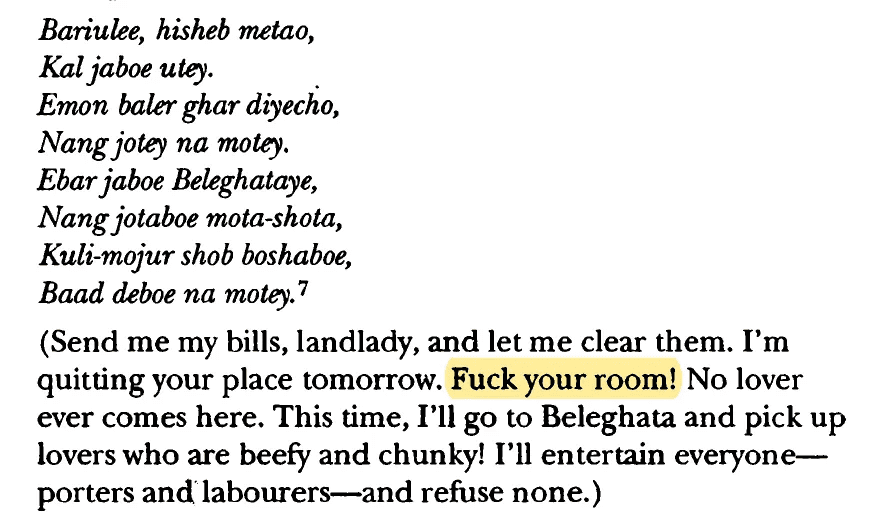
Binodini Dasi penned her autobiography which was released in 1912 that gives readers incredibly poignant insight into her and the lives and deaths of other sex workers. None of these women are solely of the past. They were the voices of the gramophone age. They had a history long before that and they have a present. Zareena Begum, a court courtesan who studied under Begum Akhtar, passed away in 2010 impoverished and largely forgotten. Asgari Bai was a hereditary court singer who excelled in dhrupad but who passed away in 2006 inside a small hut after teaching students in an even smaller government-provided space. There are more. Many more women are languishing in unseen and unheard rooms. Talented and knowledgeable women who have not only been erased but aggressively deprived of healthy lives by post-colonial states. There is a world of dedicated music lovers who seek to uncover records and other physical legacies but what of the women who built those legacies? What of the ones unnamed till today. The ones who continue to have nothing despite giving so much. The sentiment of a popular 19th century song amongst Bengali sex workers reproduced by Sumanta Banerjee remains:
Sources:
Michael Kinnear: The Gramophone Company’s First Indian Recordings, 1899–1908
Premankur Biswas: A Voice From Long Ago
Rimli Bhattacharya: Public Women in British India: Icons and the Urban Stage
Michael Kinnear: Beka Record Discography
Amar Nath Sharma, Madhu Bala Joshi: Bajanaama
Sanjay Joshi: Fractured Modernity- Making of a Middle Class in Colonial North India
Geetha Thatra: Contentious (Socio-spatial) Relations: Tawaifs and Congress House in Contemporary Bombay/Mumbai
Ashwini Tambe: Codes of Misconduct- Regulating Prostitution in Late Colonial Bombay
Anna Morcom: Illicit Worlds of Indian Dance- Cultures of Exclusion
Sumanta Banerjee: Under The Raj- Prostitution in Colonial Bengal
Davesh Soneji: Unfinished Gestures- Devadasis, Memory, and Modernity in South India
Davesh Soneji: On Indian Classical dance
Amanda Weidman: Singing the Classical, Voicing the Modern- The Postcolonial Politics of Music In South India
Times of India: The Last Devadasis of Madras
Sandhya Iyer: My Name is Gauhar Jaan- the Life and Times of a Musician
Shailaja Tripathi: For the Record
Matthew Atmore Sherring: Tribes and Castes of Benaras
G N Joshi: A Concise History of the Phonograph Industry in India
Sangeetha Shyam: Vintage Devadasi Video and Audio
Kalpana Kannabiran, Vasanth Kannabiran: Muvalur Ramamirthammal’s Web of Deceit- Devadasi Reform in Colonial India
Gerry Farrell: The Early Days of the Gramophone Industry in India- Historical, Social and Musical Perspectives
Binodini Dasi (translated by Rimli Bhattacharya): Amar Katha, My Story
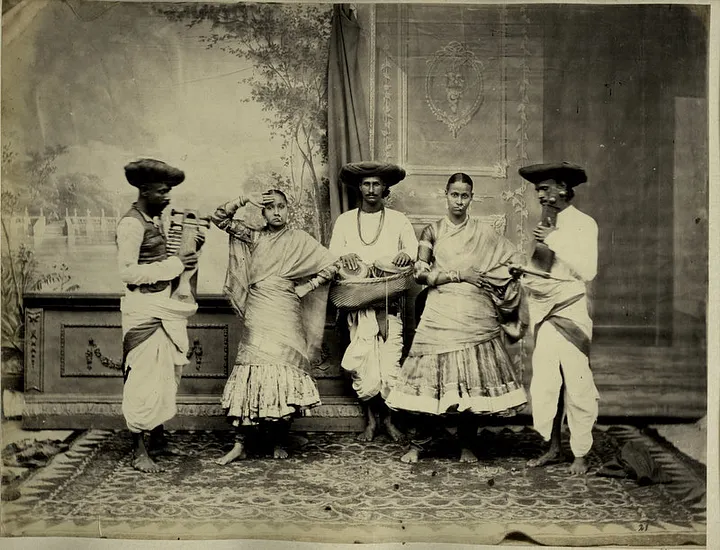
Cover image: Unnamed talent. Unnamed location. Circa 1870.